Roles · updated 3 September 2026
Chief AI Officer (CAIO): the seat that did not exist two years ago.
A Chief AI Officer (CAIO) is the executive who owns AI strategy, risk and governance across every function of a company. IBM's Institute for Business Value reports that 76% of the organisations it surveyed had a Chief AI Officer in 2026, up from 26% a year earlier. Whether your company needs one comes down to a single question: who owns AI risk today. This page says what the job is, when it makes sense, and what it means for the CTO sitting next to it.

The numbers behind the title
IBM does not publish the sample size behind its survey, and the 76% almost certainly describes large enterprises rather than the average company. Read the row as direction, and the Gartner rows as the reason: the AI mandate is landing on engineering leaders whether or not anyone creates a new seat for it.
| What | Figure | Source |
|---|---|---|
| Surveyed organisations with a Chief AI Officer, 2025 | 26% | IBM Institute for Business Value |
| Surveyed organisations with a Chief AI Officer, 2026 | 76% | IBM Institute for Business Value |
| Engineering workforce that must upskill for generative AI through 2027 | 80% | Gartner, October 2024 |
| Software engineering leader role descriptions requiring GenAI oversight by 2027 | 70%, from under 40% | Gartner, via DevOpsDigest |
What a Chief AI Officer leads
Engineering leadership roles: leading people, technology and AI agents. The CAIO leads the least people of the three roles on this site and carries the widest mandate.
People
A small staff and a large dotted line: every function head who is deploying AI. The job is persuasion and budget, run through the CTO, the CPO and the heads of sales, operations and finance.
Technology
The model and vendor portfolio the company is allowed to use, the data it may be used on, and the evaluation standard a feature must pass before it reaches a customer.
AI agents
Governance for systems that act: which agents may change what, with which approvals, and who owns an agent’s mistake. In the EU that now includes the AI Act’s obligations, and the regulator will ask for one name.

Does your company need one? Four questions
Ask them in the leadership meeting. If each has one clear owner and the owner is the same person, that person is your Chief AI Officer in all but title, usually the CTO. If the answers point at four different people, or at nobody, the seat is missing.
- 1Who signs off when an AI feature is wrong in production, today, by name?
- 2Who decides which model providers the company may use, and who can change that list?
- 3Who explains the token bill to finance, and who can cut it?
- 4Who answers the regulator, the auditor or the enterprise customer’s security questionnaire on AI?
In most scale-ups the honest answer to all four is the CTO, and the fix is a Head of AI under them, not a new executive. In a bank, an insurer or a group with AI in a dozen business units, the answers scatter, and that scatter is what the CAIO seat exists to collect.
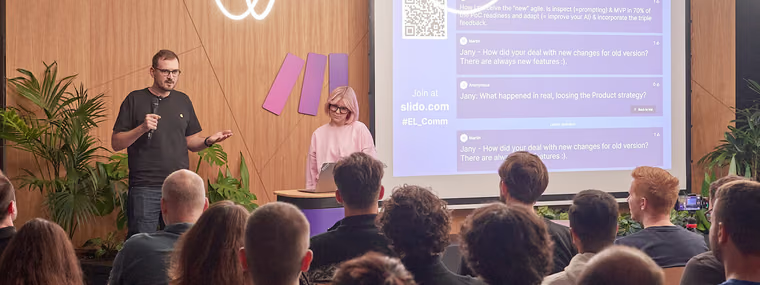
Where the CAIO conversation happens in ELC
The registry counts at least 88 CTOs and CIOs and 132 founders and executives among members with a recorded title. Most of them carry the AI mandate without the title. Full census on the statistics page.
- Executive AI Program. Built for the executive who owns AI without a team of AI engineers. Format, experts and price.
- Experienced Leaders circle. Bi-weekly with CTOs and VPs from other companies, inside company membership.
- A second opinion. 1:1 mentoring with leaders who have carried the AI mandate at board level.
- Free membership. 3,300+ engineering leaders in Prague, Brno, Bratislava and Kraków. Join ELC.
Next meetup
Questions people ask about the role
What does a Chief AI Officer do?
Owns AI across the company rather than inside engineering: which use cases get funded, which risks are accepted, which vendors are allowed, and who is accountable when an AI system fails. The CAIO usually has a small staff and a large mandate, and works through the CTO, the CPO and the heads of each function.
Does every company need a Chief AI Officer?
No. If the four questions on this page have one clear owner already, usually the CTO, the seat adds a layer. The role earns its place in regulated industries, in enterprises where AI spans many business units, and when a board wants one name for AI risk.
Chief AI Officer or Head of AI?
Head of AI builds; the Chief AI Officer decides and governs. A scale-up hires a Head of AI under its CTO. A bank or an insurer with AI in twelve departments hires a CAIO next to the CTO.
Where do Chief AI Officers come from?
From CTO and Head of AI seats, from data and analytics leadership, and occasionally from consulting. In Central Europe the title is rare; the mandate mostly sits with the CTO or a Head of AI, which is the case the Executive AI Program is built for.
Related: Head of AI, AI engineering manager, how to become a CTO, and all roles in ELC rooms.