October 24, 2026 | Marian Kamenistak
Price of running a professional meetup: €3,000 to €5,000
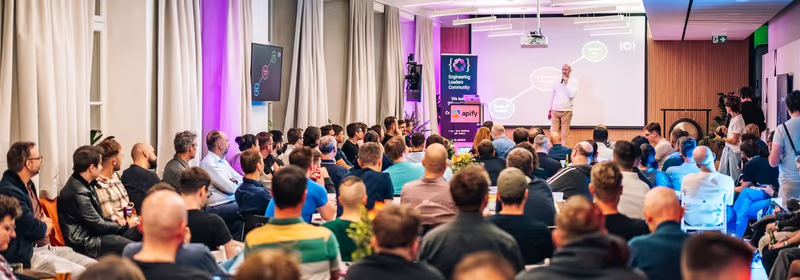
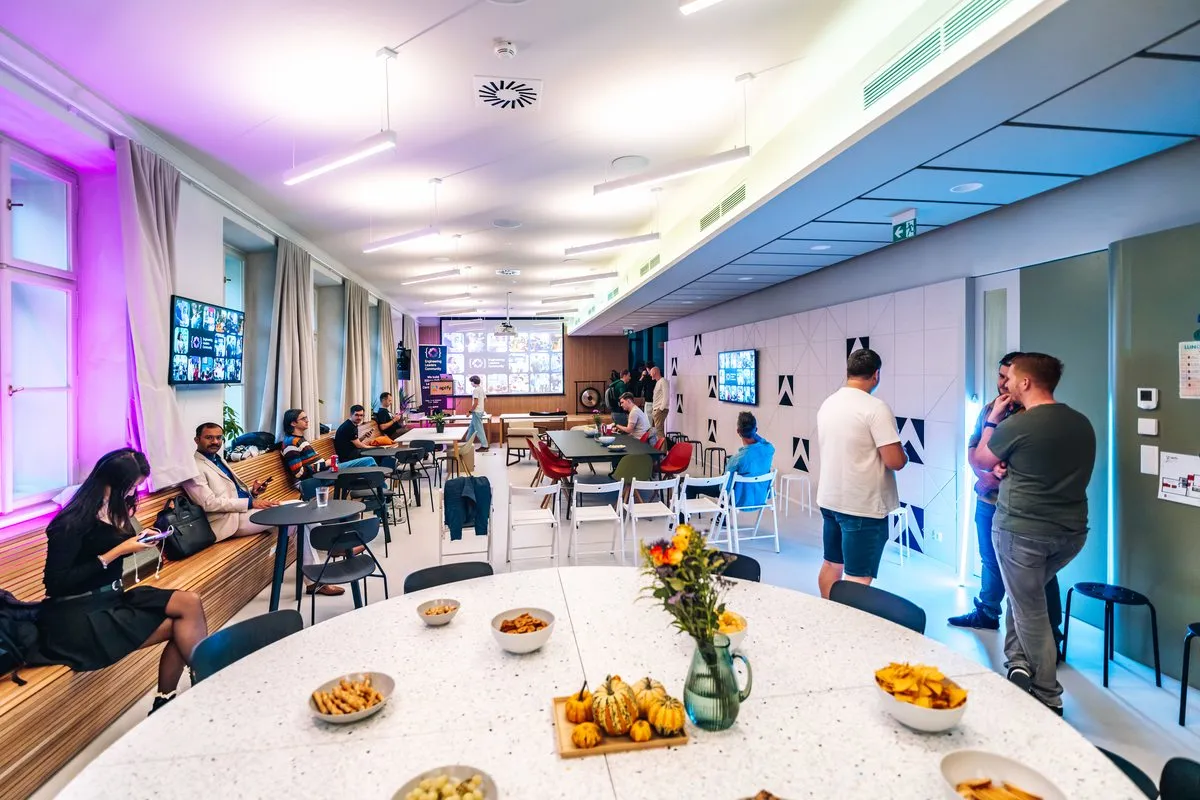
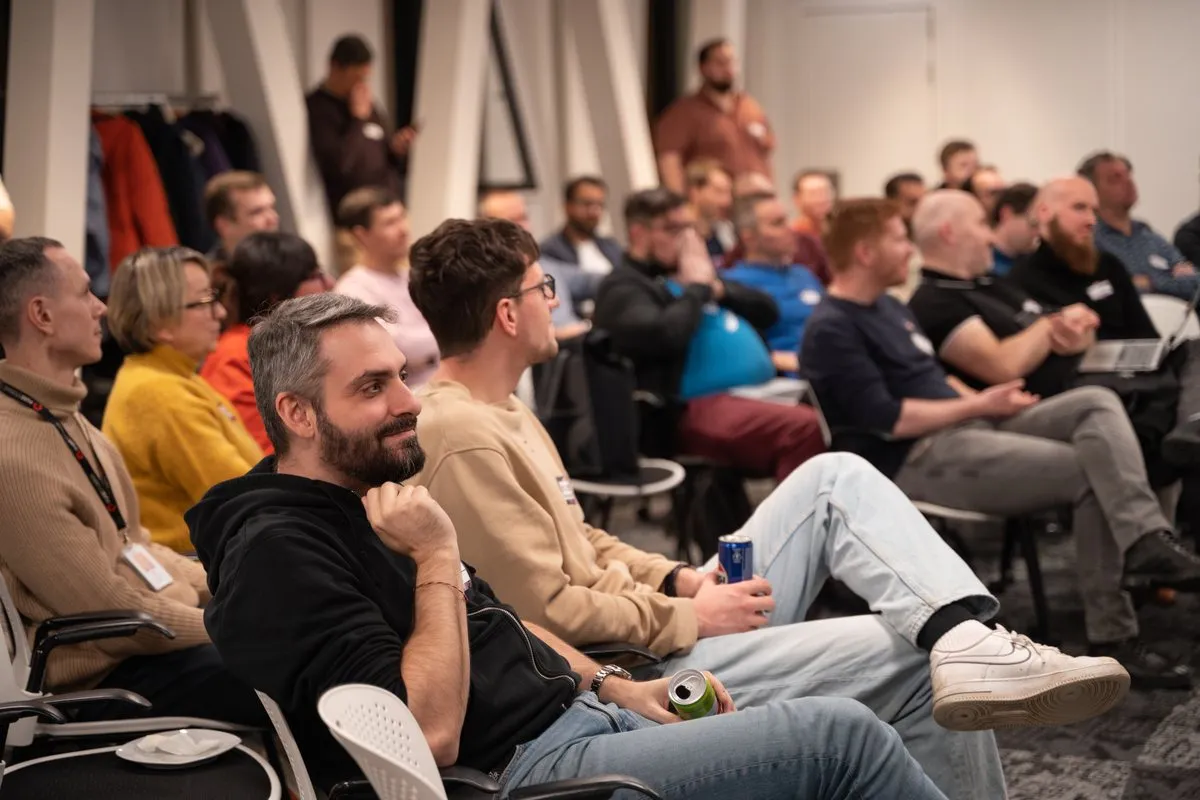
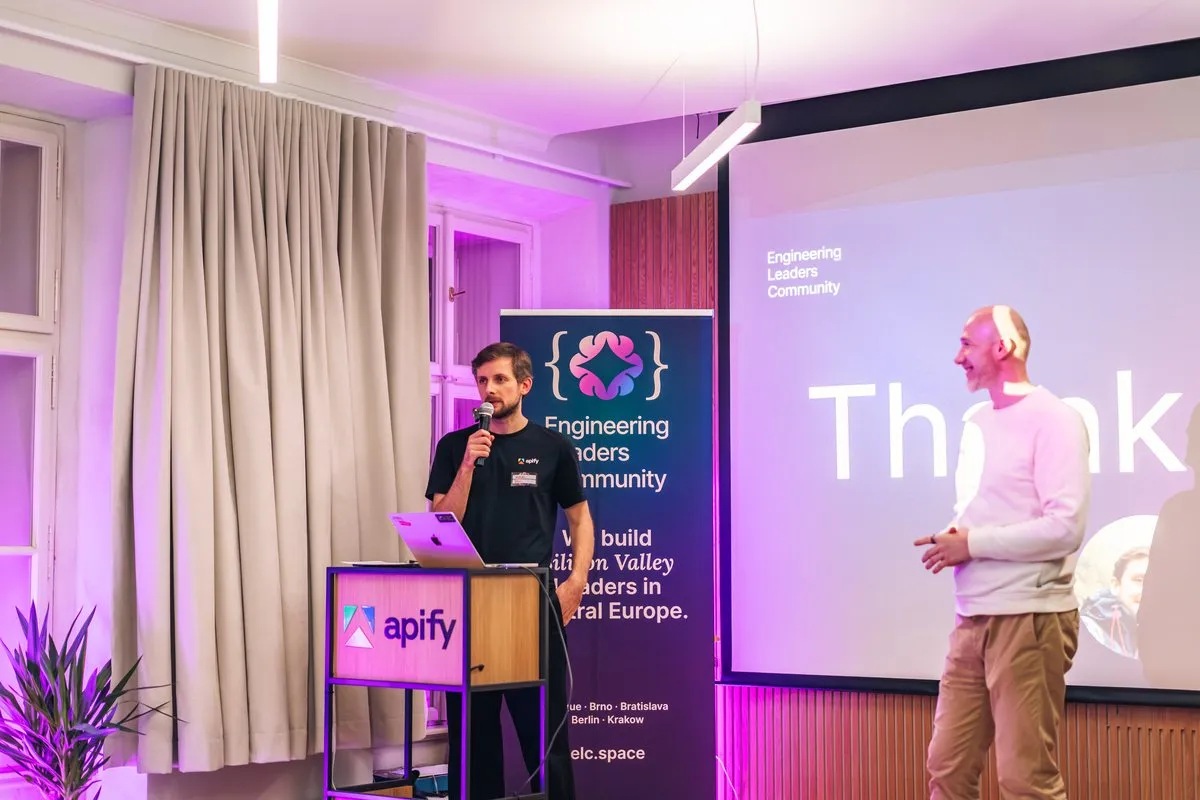
On 14 October 2026 we ran meetup #43 at Apify in Prague. 382 people applied for 200 seats and 117 checked in on the night. For the guests it was a normal good evening: talks first, then networking until the venue closed.
When a company asks me about meetup costs, or why an evening like this costs money at all, this post is my answer, with all the event costs itemised. The meetup price is €3,000 to €5,000 plus the food, depending on who brings the room.
Who does the work
Every role below is paid, except the ambassadors.
- Event manager owns the run of show: venue, catering, kit and the launch steps. Arrives three hours before the first talk and leaves after the venue is clear.
- Head of Community owns the people: waitlist approvals, check-in, first-timers, follow-ups, the debrief the day after and the retro two weeks later.
- Designer and video makes the cover graphics a month before and edits the meetup video two weeks after.
- Photographer and videographer come on the night only. Photos arrive the next day, raw video within 12 days.
- Founder, that is me: speakers, partner seats, hosting, the recap and the report for the host company.
- Ambassadors are volunteers who welcome first-timers at the door. Nothing a company pays for depends on them.
Here is what each role costs per meetup. Team hours are our estimate, priced at one blended €40 an hour. Photo, video and print are what we pay outside the team: 10 more hours, a rough split of €800.
| Role | Hours per meetup | Cost per meetup |
|---|---|---|
| Event manager | 16 | €640 |
| Head of Community | 10 | €400 |
| Designer and video | 8 | €320 |
| Founder | 6 | €240 |
| Photographer, the night and post-production | 4 | €300 |
| Videographer, the night and post-production | 4 | €350 |
| Print, name tags, extras | 2 | €150 |
| Ambassadors | volunteers | €0 |
| One meetup | 50 | €2,400 |

1. You host and cater: €3,000
This is the usual setup, and the one Apify chose for #43. Your office is the venue and you order the food. ELC does everything else, from the cover graphics 30 days before to the edited video 14 days after.
You pay ELC €3,000 for organising it, plus the food you order yourself.
Producing it costs us about €2,400. Here are those event costs task by task. Days count from the meetup night, hours are our estimate and every hour is priced at one blended €40, so you can swap in your own rates.
Before: D-30 to D-1
| When | Task | Who | Hours | Cost |
|---|---|---|---|---|
| D-30 | Cover graphics | Designer | 2 | €80 |
| D-30 | Title and abstract | Founder | 0.25 | €10 |
| D-28 | Create the event everywhere: Luma, LinkedIn, Meetup.com, slides, Slack | Event manager | 2 | €80 |
| D-28 | Intro email to the speakers | Founder | 0.5 | €20 |
| D-26 | Invite members before the public | Event manager | 0.75 | €30 |
| D-26 | Reserve seats for partner companies | Founder | 0.5 | €20 |
| D-22 | Open registration to the public | Event manager | 0.5 | €20 |
| D-22 | Invite on LinkedIn and in other Slack groups | Founder | 0.5 | €20 |
| D-21 | Submit to Luma’s city events page | Event manager | 0.25 | €10 |
| D-28 to D-1 | Venue, catering, merch, speaker logistics | Event manager | 5 | €200 |
| D-21 to D-1 | Waitlist approvals | Head of Community | 1.5 | €60 |
| D-7 to D-1 | Poll and emails to first-timers | Event manager | 0.5 | €20 |
| D-1 | Pack the kit | Event manager | 1 | €40 |
| Before, total | 15.25 | €610 |
The night
| When | Task | Who | Hours | Cost |
|---|---|---|---|---|
| 3h before to 3h after | Catering, set-up, tech check, run of show, clear-out | Event manager | 6 | €240 |
| 2h before to 3h after | Set-up, check-in, first-timers, networking | Head of Community | 5 | €200 |
| Evening | Host, speakers, partners | Founder | 3 | €120 |
| Evening | Photos | Photographer | €300 | |
| Evening | Video footage | Videographer | €350 | |
| Evening | Print, name tags, extras | Event manager | €150 | |
| Night, total | 14 | €1,360 |
After: D+1 to D+90
| When | Task | Who | Hours | Cost |
|---|---|---|---|---|
| D+1 | Count check-ins, request photos, 15-minute debrief | Head of Community | 1 | €40 |
| D+2 | Check the photos, thank attendees, email no-shows | Head of Community | 1 | €40 |
| D+2 to D+3 | Recap, speaker thank-you, report for the host company, 5 coffee invites | Founder | 1.25 | €50 |
| D+7 | Follow-ups with attendees | Head of Community | 1 | €40 |
| D+14 | Edit and publish the video | Designer | 6 | €240 |
| D+14 | Retro and wrap-up | Head of Community | 0.5 | €20 |
| D+90 | Archive the Slack channel | Head of Community | ||
| After, total | 10.75 | €430 |
The night is 14 of the 40 hours. The other 26 happen where no guest sees them, and they are the hours a host company is paying for.
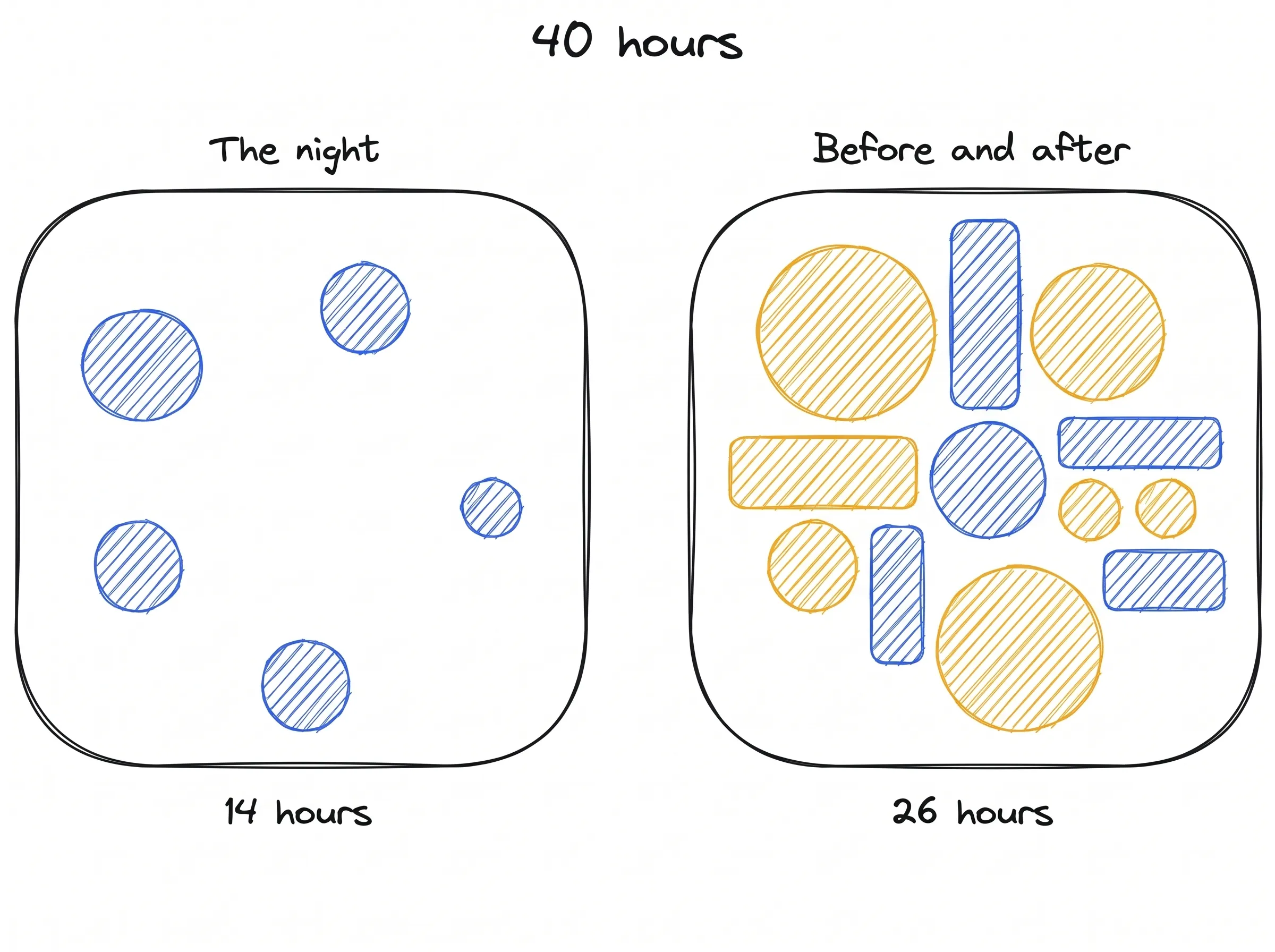
Added up per role, that is the €2,400 in the table under who does the work. With 117 people checked in at #43, that is about €21 per person in the room.
2. No venue, no catering: €5,000 plus food
Some companies want the meetup but have no room for 120 people, or they don’t want to deal with the food. Then ELC brings both. You pay ELC €5,000, and the food at cost on top.
| Line | Our cost | You pay |
|---|---|---|
| Production, as above | €2,400 | |
| Venue for the evening | €2,000 | |
| Organisation and venue | €4,400 | €5,000 |
| Food and drinks for the room | about €1,500 | at cost, about €1,500 |
The food line moves with the headcount, so a smaller room costs a bit less and a full one a bit more. All in, the event budget is about €6,500, or roughly €55 per person at #43’s check-ins.
3. What we charge, and why
| Setup | You pay ELC |
|---|---|
| You host and cater at your office | €3,000 |
| ELC brings a coworking venue | €5,000 |
| ELC orders the food | at cost, about €1,500 |
These prices are costs only, with zero margin on top. The €3,000 is more than the €2,400 bill above because that bill counts only the hours we can book against one night. It leaves out partner sales, scouting speakers months ahead, the tools, and building the runbook in the first place.
It also leaves out the expensive part, the audience. A company’s first meetup of its own starts from the people it can personally invite. Ours start from 3,600+ members and a median of 125 registrations across 40 meetups. That’s what you pay for, much more than the food.
Two more things make the price easier to say yes to:
- The fee comes back. Sign a company membership within 90 days and the full meetup fee counts towards it.
- Inside a yearly package, the first meetup is on us. ELC drops the organisation fee. You pay the food at cost, and a venue only if we have to rent one. If the evening convinced you, the rest of the year is one invoice. If not, you walk away.
How to attract tech talent in 2027: bring them to your office
A meetup at your office puts senior engineers inside it for an evening. They hear your engineer on stage, see where the team works and talk to your people after the talks. A job ad can’t do that.
They want to come. 382 people applied for the 200 seats at #43 at Apify, and 316 applied for the 120 seats at Ataccama HQ for #30.
When you have open roles, Quarterly Hiring with a Meetup puts engineering leaders in your office, then adds 3 months of intros for your open roles, curated by Marian. It’s €8,000 one time plus €12,000 per hire, paid when the person starts. A recruiter charges €15 to €25K per senior hire. How the employer brand around it works is on employer branding through engineering events.
Who can run a meetup for your company
Three options, from the most work on your side to the least:
- Your own team. The tables above are the bill: about 40 hours a meetup, every month. It works when someone on your side owns the speaker network, the venue, the promotion, the topic and the calendar. The free readiness check scores those five.
- ELC, for one evening. One meetup at your office for €3,000, or €5,000 at a venue we secure.
- ELC, for a series under your own name. Community Launch builds an engineering community under your company’s name in a Czech, Slovak or Polish city. The Launch Audit costs €3,900. Community Launch, €25,900, runs three meetups in about four months with ELC members seeded in, then hands your team the playbook. Launch + Run, €46,900, keeps ELC on it for six meetups a year.
Why ELC is for-profit
ELC started amateur too, in 2019, like most meetups.
Andy Grunwald ran Web Engineering Düsseldorf from 2012 to 2023 as a volunteer: 90+ meetups and 4,500+ members, as he writes, “non-profit, voluntary, in your free time”. It worked, and I won’t pretend volunteer meetups can’t be good.
What volunteers rarely sustain is the same quality every month. The report for the host company three days after. The edited video two weeks after. 20 usable photos within two days, not when someone finds a free evening.
From my experience, pro people cost money, and pro meetups, events and experience come from pro people. That is why ELC is a company and not a club. Quality costs money, and the people fighting for the mission need to be financially secure.
Without pro delivery, no partner would want to work with us. These companies did:
- Ataccama, their year with ELC
- Barclays, their year with ELC
- Everpure, formerly Pure Storage, their year with ELC
- Apify, their year with ELC
- Microsoft
- ČSOB
- Bloomreach
- Kiwi.com
- Make
Four of them have a public review of their year with us, meetup by meetup.
How the runbook halved the launch
Paying people is half of it. The other half is making sure they never have to remember 48 steps. Each step has an owner, a day and a script. The script opens the Luma event, drafts the email or posts the Slack message, and stops for a human where judgment is needed. Venue, catering and the night itself stay human work.
One example: the day before every meetup, a script posts the registered guests from potential partner companies into the team’s Slack, so the host knows whom to meet.
The first time we ran the launch steps, for meetup #42 on 28 August 2026, the sitting took about four hours. For #43, on 16 September, the same steps took about two. Same tasks, same quality bar, half the time. That is two runs so far, not a law.
A runbook alone won’t save a volunteer team, though. Somebody has to be paid to keep it working.
Pick yours
- You lead engineering and have an office. Show the engineering culture you want to hire into. One meetup at your office, €3,000.
- You hire senior engineers or engineering managers. Hiring engineers through a 120+ registered meetup at your office. Hiring with a meetup, €8,000 plus €12,000 per hire.
- You sell to engineering teams. Put your platform in front of the people who approve budgets. Build your membership, every line item priced.
- You’re opening a new CEE office. Meet the local leaders in one evening, ELC brings the venue. One meetup at a venue we secure, €5,000.
- You want a year, not one evening. The first meetup is on us. See the yearly packages.
What a membership includes and costs over a year is in how tech companies partner with engineering communities.
Questions people ask
How much does a professional tech meetup cost?
A professional tech meetup costs €3,000 to €5,000, plus food at cost. ELC charges €3,000 when a company hosts it at its office. Without a room, ELC brings a coworking venue and charges €5,000. Food and drinks come on top at cost, roughly €1,500 for a full room.
What does it cost ELC to produce one meetup?
Producing one ELC meetup costs about €2,400 and 40 team hours by our estimate, when the host provides the room and food. That is €1,600 of team time at a blended €40 an hour, plus roughly €800 for photos, video, print and extras. Renting a venue and paying for food brings it to about €5,900.
Why does ELC charge for a meetup?
ELC charges because a meetup companies rely on every month needs paid professionals. That means an event manager, a Head of Community, a designer who edits the video, a photographer and a videographer. The €3,000 fee also covers work that doesn't appear on one night's bill: speaker scouting, partner sales, tools and the runbook.
Who can run a tech meetup for my company?
Your own team, if someone owns the speakers, venue, promotion, topic and calendar every month. ELC can run one evening at your office for €3,000. For a series under your company's name, ELC's Community Launch runs three meetups in about four months for €25,900, then hands your team the playbook.
How do you attract tech talent in 2027?
Bring senior engineers into your office. A meetup there lets them hear your engineer on stage and meet the team, and the demand is real: 382 people applied for 200 seats at ELC's meetup at Apify. ELC's Quarterly Hiring with a Meetup adds three months of curated intros for €8,000 plus €12,000 per hire.
Is Engineering Leaders Community a nonprofit?
No, Engineering Leaders Community is a for-profit company, funded by company memberships and partnerships since 2019. Paying a professional team is what keeps the meetups at the same quality every month. Donations are a separate track: a foundation to receive them is planned for registration in 2027.
How many hours does it take to organize a tech meetup?
Organizing one tech meetup takes about 40 team hours by our estimate. The event manager spends 16, the Head of Community 10, design and video 8, and the founder 6. Only 14 of those hours happen on the night. The work runs from 30 days before to 14 days after, plus one cleanup task at day 90.
For companies
Show the engineering culture you want to hire into.
Your venue, your speaker, ELC runs the rest: 120+ engineering leaders registered and €3,000 when you host.
See how hosting worksFor companies
Hiring engineers through a 120+ registered meetup at your office.
Several open roles, and you want the room to know your team. Quarterly Hiring with a Meetup at €8,000 one time, plus €12,000 per hire.
Plan the meetup